

If you asked someone living in the 19th century to tell you the rate of economic growth, they would be slightly bemused. It is only in the last century that we have started measuring the state of the economy, primarily using Gross Domestic Product (GDP). Many economists believe that we have become obsessed by this measure, and need to broaden our horizons.
Measuring National Income
In the quest to measure living standards, it may appear perfectly sensible to focus on the income available to the residents of a country. More money gives access to the purchase of more goods and services, both necessities and luxuries, and therefore a higher standard of living.
It is worth being aware of the various approaches to measuring national income, as well as their associated terminology:
- Gross Domestic Product (GDP): the total value of all output produced within a country during a period of time.
- Gross National Income (GNI): the total earnings generated by a country’s residents and businesses, regardless of their location.
- GDP or GNI per capita: it is common to see the above figures divided by population to show incomes per person. China or USA will of course have a higher GDP than the UK or France due to their respective size — per capita figures are therefore more meaningful when comparing living standards.
- Real GDP or GNI: incomes tend to grow each year purely due to rising prices (inflation). Real figures make adjustments for this in order to see whether the actual amount of goods and services produced has risen, rather than the same output getting more expensive.
- Purchasing Power Parity (PPP): adjusting market exchange rates to reflect more accurately the goods and services that a currency could actually purchase in a given country. In countries where labour costs are very low, products tend to be cheaper. One US dollar in Malaysia or Bali would get you a lot further than a dollar in USA. National income statistics should be adjusted for this when comparing standards of living between nations.
Is GDP Fit for Purpose?
There are huge problems with focusing on GDP as a measure of economic performance. It measures everything from haircuts to houses built, and in doing so it measures a lot of things we might prefer it didn’t. That coal-fired power station belching out emissions, harming asthmatics and warming the climate is merrily contributing to GDP with its output. When a country is hit by a hurricane and has to rebuild brick by brick, expenditure on this work may see GDP rise, but could anyone really argue that they are better off than they were before?
Equally, there are so many things which contribute to our economy that GDP leaves out. When you drop your kids off at nursery and get a bill at the end of the month, this rightly counts as GDP. If these same kids were to be looked after by generous grandparents five days per week, it would have no impact on GDP.
Even more starkly, if you were to turn your garden into a vegetable patch and grow your own dinner every night, you would not contribute to GDP. If you went to the shops and bought the same vegetables, GDP would rise.
Alternatives?
The Human Development Index (HDI) was created by the economist Mahbub ul Haq in 1990. It brings together three elements:
- A measure of income: GNI per capital (PPP$)
- A measure of education: mean and expected years of schooling
- A measure of health: life expectancy at birth
Equal weightings are given to each element and an index number between 0 and 1 is created. A higher index is an indicator of increased development and higher living standards. Even this would be woefully incomplete, however. What about inequality? Environmental degradation? Levels of corruption? We could go on.
There is a field of economics which focuses on subjective measures of wellbeing to inform these judgements — how happy are the residents of a country? ‘Happynomics’ is an enticing approach, but has its own problems. Where do you start with measuring happiness?
The Doughnut
In her 2017 book Doughnut Economics, Kate Raworth has constructed a compelling alternative approach.
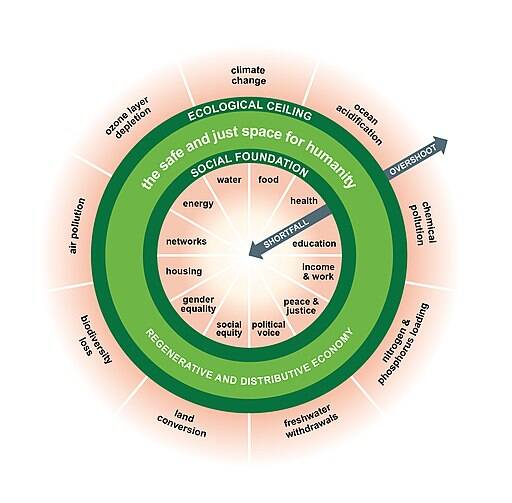
The nine planetary boundaries, outside the doughnut, are factors which must not be overshot if we are to protect the planet. There are also twelve social standards, inside the doughnut, which should be met if we are to provide for the needs of the current generation. You will note that income and work is just one of twelve.
Individuals and, more importantly, policymakers, would do well to take heed of the lessons from the doughnut if we are to wean ourselves off our obsession with GDP and create a more sustainable future.
Add comment
Comments