

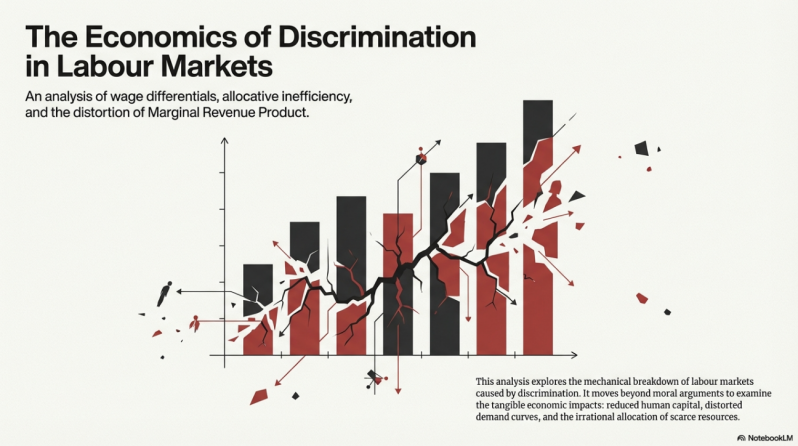
Discrimination unfortunately occurs in all walks of life, but one of the areas where it can be most damaging is in labour markets. This is because it negatively affects not only individuals, their prospects for obtaining jobs at a fair wage and grasping promotion opportunities, but also the firms taking the decisions as well as the wider economy.
Types of Discrimination
The most obvious type of labour market discrimination is wage discrimination. This occurs when employers pay workers differently based on characteristics irrelevant to the job they are completing. In order for them to do this effectively, they should have the power to set wages (i.e. the labour market must not be perfectly competitive where firms accept the going market wage), and they should be able to identify and separate different groups of workers. This is most straightforward for employers based on easily observable characteristics such as ethnicity or gender, however does still occur based on others such as religion or sexuality.
In the UK, The Equality Act (2010), pulled together other more fragmented forms of legislation to provide legal protection from all forms of discrimination in the workplace. Sadly though, it does still occur far more than we would hope. For example, there is significant evidence that workers from ethnic minority groups find it harder to be accepted for interview and therefore to find meaningful employment. In the UK in 2022 the mean ethnic pay gap in hourly pay was 22.6%.
The Gender Pay Gap
The United Nations own review of women's rights puts the global gender pay gap at 16%. It is significantly higher than this in some countries. One reason for this is undoubtedly workplace discrimination, where men can be favoured for higher skilled, higher paid jobs. However, there are also significant societal drivers of this inequality, such as:
- Globally, girls are less likely to get a full education than boys.
- Women are more likely than men to take time out of the labour force to fulfil childcare needs.
- Even as gender stereotypes are increasingly challenged, women are still more likely to complete the lions share of unpaid household work.
Consequences of Discrimination
It would be easy to categorise these examples of discrimination as a moral issue based on equity and fairness, however there are also material economic impacts which we should consider as well.
Workers from unfavoured groups being underpaid or ignored for job interviews become much more likely to withdraw from the labour force altogether. As well as the harm to the individual, this has a macroeconomic impact by shrinking the size of the labour force and reducing the productive capacity of the economy.
Firms can also be harmed by the impact of their own discrimination. Numerous studies have shown the benefits of diversity in teams. In his book Rebel Ideas, Matthew Syed writes about the negative impact that homogeneity of ethnicity, gender, and class background had on the CIA throughout the second half of the twentieth century. Additionally, discriminatory firms will find that they miss out on the best candidate for the job based on their own prejudices. This will harm their productivity and make generating output more costly as a result.
Estimating Marginal Revenue Product
Throughout our work on labour markets we have discussed the importance of marginal revenue product (MRP) to firms in making their employment decisions. MRP is the additional revenue that employing one extra worker will bring to the firm, and will be critical to determining how many workers to employ. Economic theory suggests that firms should employ workers only up to the point where MRP is equal to the marginal cost of employing the extra worker.
The problem with discrimination is that firms will incorrectly estimate the MRP of different groups based on whether they are artificially favoured or unfavoured. This can be illustrated in the diagram below.

MRPf shows the firms estimation of the additional revenue that favoured groups will generate, which is higher, and therefore further to the right than the MRP of unfavoured groups (MRPu). These incorrect estimations will distort labour markets, encouraging firms to employ too many workers from favoured groups at too high a wage, and not enough from unfavoured groups at a reduced wage.
All of this means that the government must play a crucial role in reducing labour market discrimination, not only for those discriminated against, but for the benefit of the wider economy. Legislation such as the Equality Act plays an important part in this, but other more innovative measures can help too.
Finland have a system of heavily subsidised childcare which puts the UK to shame and helps parents get back to work effectively. Increasing the minimum wage is an important intervention as groups subject to discrimination often find themselves closer to the legal minimum in their pay. Encouraging companies to publish data on their gender pay gap acts as a call to action for those with bigger gaps to enact change. These sorts of measures should sit alongside laws and regulations to provide a fairer labour market for all.
Add comment
Comments