

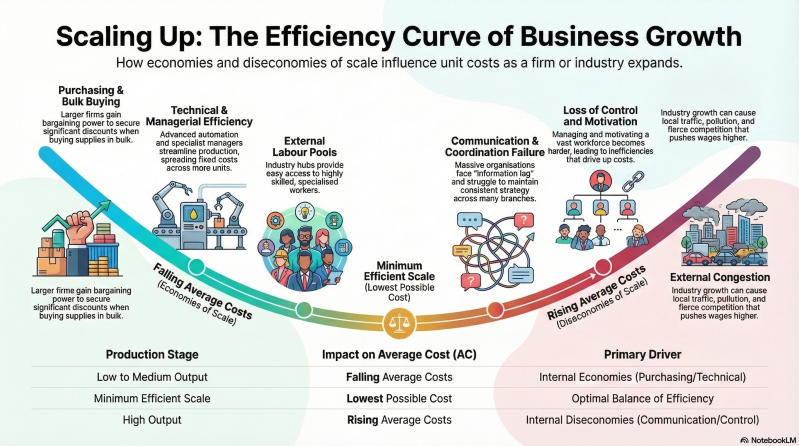
It is easy to see that larger firms benefit from additional customers, market share and sales. Less obvious may be the impact on their costs of production, more specifically their cost per unit. The existence of internal and external economies and diseconomies of scale can help to explain this.
Short and Long Run
It is important to be clear that economies and diseconomies of scale occur in the long run. That is the time period in which all factors of production (land, labour, capital and enterprise) can be varied. This might be a supermarket opening a number of new stores, or a building firm beginning construction on a new site.
Compare this with the short run, where at least one of the factors of production remains fixed. A restaurant can employ an additional chef in the short run (without making any changes to their premises or capital equipment). When a business grows, it may experience diminishing marginal returns in the short run. For example, the additional chefs will find it harder and harder to keep expanding the restaurant’s output with the same capital equipment (e.g. kitchen space and tools). This will impact on a firm’s short run average cost (SRAC) and should not be confused with economies and diseconomies of scale, which impact long run average cost (LRAC) and will be our focus here.
Internal Economies of Scale
Internal economies of scale occur when a firm increases its scale of production and long run average costs are reduced as a result. Clearly, the firm’s overall costs will increase as it grows, but crucially its cost per unit of output produced is likely to fall. The cost per burger produced by McDonalds will be significantly lower than an independent burger shop. Why is this?
- Purchasing. This is probably the most obvious, and is often referred to as ‘bulk buying’. Suppliers will give discounts to purchasers buying in larger quantities. An order of 500 kilograms of beef will invariably cost less per kilogram than a 5 kilogram order.
- Marketing. Advertising is a fixed cost. Burger shops don’t pay for an advert per burger sold. This means that, in larger businesses, these marketing costs are spread over more units, meaning that the cost per unit falls.
- Technical. Larger businesses have access to more advanced and specialist production equipment. While this will have a high initial cost, on a very large scale it increases productivity and reduces cost per unit.
- Financial. Lenders will primarily consider the risk involved when they offer loans to businesses. Larger and more established businesses are considered a ‘safer bet’. This means that such firms can access loans at lower rates of interest, which reduces cost per unit.
- Specialisation. A small independent burger shop might only have a handful of workers. As they grow and employ more staff, specialists begin to take over who will naturally be more productive in their area of expertise. Once again, this helps to drag down unit costs.
Internal Diseconomies of Scale
Conversely, growth may also result in diseconomies of scale, where the rising scale of production results in rising long run average costs. This is most likely to occur when firms become especially large. Two reasons for this are outlined below:
- Communication. A business with branches in London, Sydney and New York will need to find ways to communicate effectively. This might involve costly long-haul flights for meetings (although, these days, this is likely to be mitigated by the use of video conferencing). Breakdowns in communication in large organisations can also result in expensive mistakes.
- Motivation. The chef in that small independent burger shop will very clearly see the impact of their hard work in terms of business success. A chef in a larger chain cannot see this and so might feel that their work is less rewarding. Bigger businesses therefore need more extensive motivation and reward systems, the expense of which can push up cost per unit.
External Economies of Scale
So far, we have analysed internal economies of scale (i.e. the effect of the growth of an individual firm). External economies of scale are experienced when the scale of production in a whole industry expands. Examples of this might include Silicon Valley in the USA, or the concentration of Formula 1 teams in the UK Midlands. In these cases, lower average costs are due to:
- Improved infrastructure and transport links. As firms concentrate in one area, roads, train stations, airports all emerge nearby. This makes the movement of labour, materials and finished goods easier and cheaper.
- Access to skilled labour. Software engineers and programmers are more likely to locate to Silicon Valley as they know this is where they can get jobs. Firms benefit from this, as they don’t have to spend time and money searching far and wide for the most skilled staff.
- Suppliers can benefit from lower distribution costs. If all the F1 teams are located in the midlands, a tyre manufacturer such as Pirelli doesn’t need to traipse all over the UK delivering tyres. It may then pass some of this cost reduction on to the teams.
External Diseconomies of Scale
As you may have guessed, external diseconomies of scale are felt when the growth of an industry results in rising long run average costs. Reasons for this might include:
- Congestion. As employees try to get to work, deliveries arrive, and orders are shipped out, roads can become gridlocked. Having any of these resources sitting in traffic is hugely costly to businesses.
Competition. As firms compete with each other for labour and other raw materials, this can bid up their cost. If, for example, software engineers know that there are several different technology firms who want to employ them, it puts them in a strong position when negotiating for wages.
The Long Run Average Cost Curve
The concept of economies and diseconomies of scale can be illustrated on a long run average cost (LRAC) curve.

At low levels of output, economies of scale dominate. The firm is not yet large enough to experience significant communication or motivation problems, and therefore LRAC falls due to all of the possible internal economies of scale. As growth continues, however, the benefits of even greater scale begin to tail off. Suppliers are unlikely to give further bulk discounts to a burger shop ordering 501 kilograms of beef rather than 500 kilograms. Once a business is well established, lenders will see little difference in risk profile as growth accelerates further.
Beyond a certain point, then, the diseconomies of scale begin to kick in and become more dominant. Very large firms start to experience increasing issues with communication and motivation. LRAC starts to rise.
The lowest point on the LRAC curve is known as the minimum efficient scale. This is where cost per unit is minimised and the firm is being productively efficient.

This final diagram shows how we can illustrate both internal and external economies and diseconomies of scale on the LRAC curve.
- Point A shows internal economies of scale — LRAC is falling as a result of rising quantity of output.
- Point B shows external economies of scale — the entire LRAC curve has shifted downwards. This shows a lower average cost at each level of output produced by the individual firm, due to benefits experienced from the growth of the industry.
- Point C shows external diseconomies of scale — the entire LRAC curve has shifted upwards. The growth of the industry has resulted in higher average costs for the firm.
- Point D shows internal diseconomies of scale — LRAC is rising as a result of rising quantity of output.
- Point E shows the minimum efficient scale — the lowest point of the LRAC where the firm is productively efficient.
The unit cost savings from increasing scale of production are a key benefit of growth for firms. It means that they can either choose to pocket the wider profit margins, or make themselves more competitive by passing on some of the cost savings to consumers in the form of lower prices. In many industries, these economies of scale act as a significant barrier to entry — making it very difficult for new entrants to the market to compete with large incumbents. However, it remains important for firms to keep an eye on the diseconomies of scale which can occur as a result of excessive growth.
Add comment
Comments